Updated
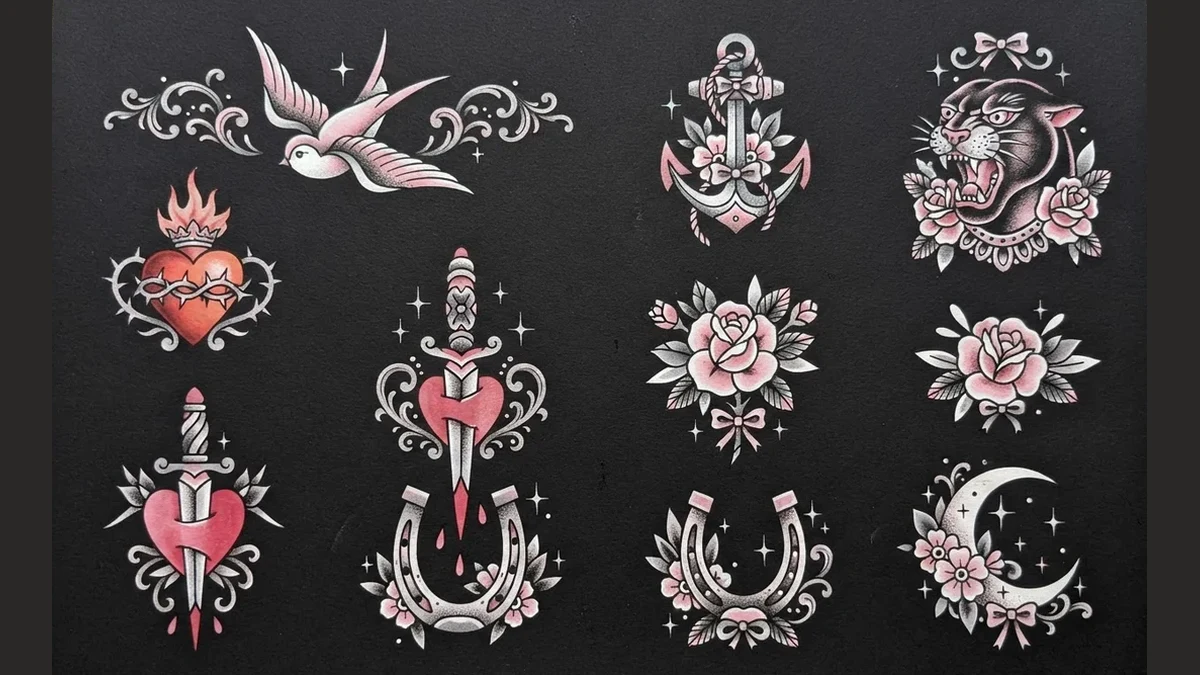
Most classic tattoo symbols have meanings that go back more than a century, to sailors, soldiers and the street-front tattoo shops of the early 1900s. A swallow means coming home safely, an anchor means staying steady, a dagger through a heart means loss or betrayal, and a rose means love, with thorns for the pain that comes with it. The meaning you give a tattoo matters more than any rulebook, but knowing the traditional story helps you choose, and helps you explain it when people ask.
This A to Z covers the symbols you’ll see on almost every traditional flash sheet, plus the newer favourites people ask about most.
Quick answer: Swallow = coming home. Anchor = stability. Rose = love. Dagger = courage or betrayal. Sacred heart = devotion. Panther = strength. Skull = mortality. Moth = transformation.
In this guide
A to F
- Anchor: stability, staying grounded and hope. Sailors got one after crossing the Atlantic. Today it often means a person who keeps you steady.
- Arrow: direction and moving forward. An arrow has to be pulled back before it flies, so it also stands for setbacks that lead to progress.
- Bat: night, intuition and rebirth. In Chinese tradition the bat is a symbol of good luck, which surprises a lot of people.
- Bee: hard work, community and loyalty. In Manchester the worker bee became a symbol of the city’s unity after the 2017 arena attack.
- Bow: femininity, playfulness and being “tied” to someone. A favourite in girly and gothic styles.
- Butterfly: transformation, freedom and the soul. Often chosen to mark a big life change.
- Cherries: sweetness, flirtation and youth. A pin-up classic.
- Clock: time passing. With no hands it can mean living in the moment. With a set time, it marks a birth or a loss.
- Compass or nautical star: finding your way home. The nautical star was a sailor’s guide.
- Crescent moon: intuition, cycles and new beginnings.
- Crown: power, self-worth and leadership.
- Dagger: courage and facing danger. A dagger through a heart usually means betrayal or heartbreak. A dagger through a rose means beauty and pain together.
- Diamond: strength and something that can’t be broken.
- Dice: luck, risk and taking a chance on life.
- Dragon: power and protection in East Asian tradition, rather than the evil monster of European stories.
- Eagle: freedom, courage and patriotism. A traditional favourite in American flash.
- Eye: protection and awareness. The eye of providence and the evil eye both guard against harm.
- Feather: freedom, lightness and sometimes remembrance.
G to M
- Gypsy or lady head: a pin-up classic. Traditionally a symbol of luck and fortune telling.
- Hand of Fatima (hamsa): protection, mostly from North African and Middle Eastern tradition. Worth reading about before you get one.
- Heart: love, of course. A heart with a banner is the classic way to honour someone, such as “Mum”.
- Horseshoe: good luck. Points up to hold the luck in.
- Hourglass: time running out, and making the most of it.
- Key: freedom, secrets or the key to someone’s heart. Often paired with a lock.
- Koi fish: perseverance. Japanese legend tells of a koi that swam up a waterfall and became a dragon.
- Lighthouse: guidance and safety through hard times.
- Lion: courage, strength and family pride.
- Lotus: growth through difficulty. It rises out of mud and opens clean.
- Mermaid: temptation and the sea. A sailor’s tattoo that’s now just as popular for its beauty.
- Moth: transformation and being drawn to the light. A death’s-head moth is darker, linked to mortality.
- Mountain: challenges overcome, or a love of the outdoors.
N to S
- Owl: wisdom and seeing what others miss.
- Panther: strength, power and fierceness. The crawling panther is one of the most popular traditional designs of all.
- Peony: wealth, honour and good fortune in Japanese tattooing.
- Phoenix: rising again after something hard.
- Pin-up girl: a nod to the sailors and soldiers who carried pictures of loved ones. Now mostly worn for the art and attitude.
- Rose: love and beauty. A red rose is romance, a yellow one is friendship, and a black rose often marks a loss.
- Sacred heart: a heart with flames, thorns and sometimes a cross. It comes from Catholic imagery and means devotion and love that endures suffering.
- Scorpion: protection and danger, and a nod to Scorpio.
- Ship: adventure and a journey through life. A full-rigged ship was once earned by sailing round Cape Horn.
- Skull: mortality, a reminder to live fully. Paired with a rose, it means life and death together.
- Snake: rebirth and healing, because snakes shed their skin. Wrapped around a dagger, it means danger overcome.
- Spider web: being trapped, or time spent somewhere difficult. Some people avoid it on the elbow for that reason.
- Star: guidance and hope.
- Sun: energy, positivity and life. Often paired with a moon for balance.
- Swallow: the most famous sailor’s tattoo. Swallows return to the same place every year, so it means coming home safely. Traditionally one was earned for every 5,000 nautical miles sailed.
T to Z
- Tiger: courage and protection. In Japanese tattooing it guards against bad luck and illness.
- Unalome: a spiralling line from Buddhist tradition, showing the winding path to enlightenment. Please learn about its meaning before you get one.
- Wave: going with the flow, or a love of the sea.
- Wolf: loyalty, family and instinct.
- Yin and yang: balance between opposite forces.
Traditional pairings and what they mean
Many classic tattoos combine two symbols, and the pairing changes the meaning.
| Design | Traditional meaning |
|---|---|
| Swallow carrying a heart | Love for someone waiting at home |
| Dagger through a heart | Betrayal or heartbreak |
| Dagger through a rose | Beauty and pain together |
| Skull and rose | Life and death, love and loss |
| Anchor with a rope | Holding on through hard times |
| Snake and dagger | Danger faced and overcome |
| Sun and moon | Balance, or two people who complete each other |
| Lock and key | A love only one person can unlock |
Does the meaning have to fit your life?
No. Lots of people get a swallow without ever going to sea, and that’s fine. Tattoo meanings change over time, and the one you choose is the one that counts.
Two things are worth checking, though:
- Cultural and religious symbols. Designs like the unalome, the hamsa or sacred religious figures carry real meaning for people. Learn where they come from, and ask your artist if you’re unsure.
- Symbols linked to hate groups or gangs. A small number of designs, numbers and lettering styles have been taken over by hate groups. A good artist will warn you, but if a design has a coded meaning you don’t understand, look it up first.
Choosing your design
Start with what you want to say, then find the symbol. If it’s strength, look at the panther, lion or mountain. If it’s love, look at roses, hearts and swallows. If it’s a fresh start, look at the butterfly, moth or phoenix.
Then bring a few reference pictures to your artist rather than one exact copy. They’ll turn the idea into something that’s yours and will last well on skin. For ideas that work at a small size, see our list of small tattoo ideas with meaning.
Frequently asked questions
What tattoo means strength?
The panther, lion, tiger, mountain, lotus and semicolon are all popular symbols of strength. The lotus and semicolon are more about strength through hard times, and the big cats are about power and courage.
What does a swallow tattoo mean?
Traditionally it means coming home safely. Sailors got swallows because the birds return to the same place every year. It’s also used for loyalty and love for someone at home.
What does a dagger tattoo mean?
On its own a dagger means courage and being ready to face danger. Through a heart it usually means betrayal or heartbreak, and through a rose it means beauty and pain together.
What tattoo symbolises a new beginning?
Butterflies, moths, the phoenix, a crescent moon and the lotus are all used for new beginnings and big changes.
What is the most popular traditional tattoo?
Roses, swallows, anchors, daggers, panthers and hearts with banners are among the most requested traditional designs, and they’ve stayed popular for more than a hundred years.